OPERATING SYSTEMS / MARKET BRIEFING
How should a WhatsApp booking move from bot to human?
Automate the repeated parts of a conversation, then hand over the customer, intent, and history together. A handoff without context is a restart.
Use this whenCustomers already start or finish a booking in WhatsApp, and automation sometimes needs a staff member to take over.
HYPOTHETICAL EXAMPLE / SERVICE BOOKING
Northline Salon, a service business
This entire example is illustrative, including the company, numbers, thresholds, placements, and results.
A customer scans a storefront QR code, sends the first message, asks for an evening appointment, and mentions a skin sensitivity.
Permission source: customer scanned the storefront QR code and sent the first message. Booking replies: allowed. Marketing messages: not allowed. The bot records the requested service and time. Trigger: any mention of skin sensitivity moves the case to a person. The example ends at handoff and records no completed booking.
01 / ENTRY
Begin where the customer starts
Meta documents QR codes that can open a business chat with an optional pre-filled message. The opening message can therefore carry useful intent into the workflow.
Carry information already present in the chat into the next step. Parse only what that step needs.
02 / BOT
Give automation a narrow job
The bot can identify the requested service, collect a preferred time, and answer approved routine questions. It also records whether the customer initiated the chat and whether booking or marketing replies are allowed.
Trigger: any mention of skin sensitivity moves the case to a person. The customer sees that a staff member is joining and which booking details will be shared.
03 / HANDOFF
Transfer context, not only the conversation
Send staff the original request, captured fields, consent state, bot replies, and the reason for handoff. In this example, staff use the salon policy to confirm service suitability or decline the booking. They do not diagnose or provide health advice.
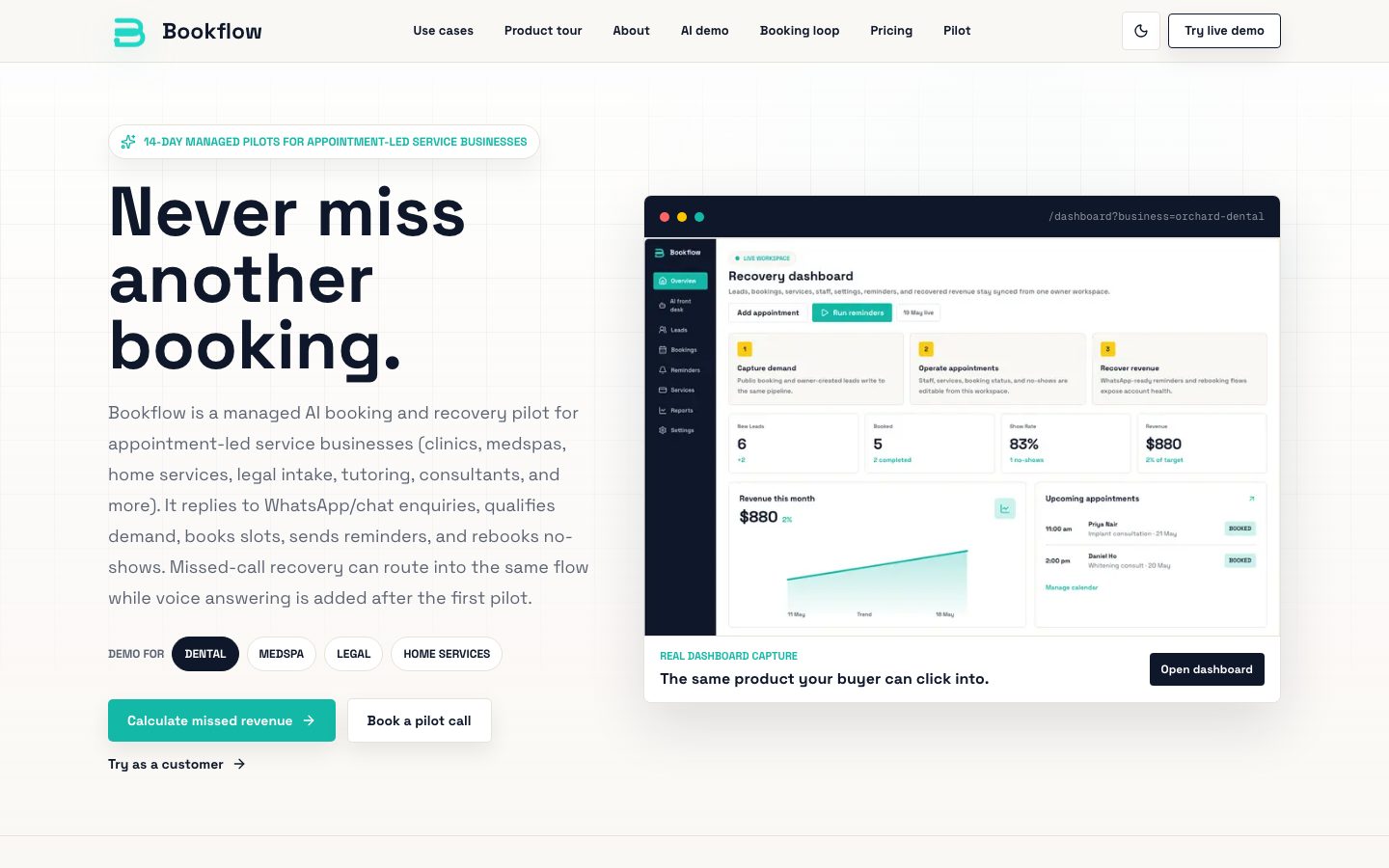
Bookflow explores this product shape around missed booking conversations. It is a public product demo, not evidence of customer adoption, an active pilot, or recovered revenue.
04 / CONSENT
Treat the inbox as customer-controlled space
Meta says people can opt in, stop chats, block businesses, and report messages. It also says business-initiated API messages use reviewed templates and marketing message limits.
Track opt-outs, complaints, unresolved handoffs, and completed tasks. More messages are not a useful result by themselves.
05 / WHEN AUTOMATION CAN FINISH
Routine bookings may stay automated
The bot may complete the booking when the customer initiated the chat, permission remains current, all required details are clear, and no health, safety, payment, complaint, or policy exception appears.
Any blocked topic, withdrawn permission, or uncertain service fit reverses that choice. Move the full context to a person, who can confirm suitability under approved policy or decline without giving health advice.
OPERATOR CHECKLIST
Use this before the next commitment
- 01What customer message starts the workflow?
- 02Which fields can the bot collect without guessing?
- 03Which topics or confidence levels require a person?
- 04What context and named owner must staff receive at handoff?
- 05How can the customer opt out, correct information, or report a problem?
DECISION ARTIFACT
Message-to-human booking flow
This exchange records where permission came from, what changed, why automation stopped, and what staff may safely do.
| Question | Evidence | Action |
|---|---|---|
| Customer initiation | Permission source: customer scanned the storefront QR code and sent the first message. Booking replies: allowed. Marketing messages: not allowed. | Record the source and consent state before the bot replies. |
| Bot | The service and preferred time are captured. The customer then mentions a skin sensitivity. | Trigger: any mention of skin sensitivity. Stop automated service advice and prepare a human handoff. |
| Health-related handoff | Staff receive the original message, booking fields, consent state, bot replies, and the health-related trigger. | Assign one owner and hold automatic confirmation. |
| Safe human action | The staff member checks the requested service against the salon approved suitability policy and asks only the allowed booking questions. | The staff member may confirm service suitability under the salon policy or decline the booking. The staff member does not provide health advice. |
| Retained context | The record keeps the service, time, permission source, current consent state, owner, trigger, and outcome. | If the customer withdraws permission, update the state and stop automated replies. Keep the history without restarting the conversation. |
The business, customer, message, consent state, staff action, and outcome are fictional. The flow is not a claim about Bookflow performance.
BOUNDARY
What this cannot decide
This flow is a product design example. It does not establish consent, privacy, health, recordkeeping, or messaging compliance for a real business. Review current policies and local requirements.
SOURCES / REVIEWED 2026-07-21
Reference desk
Sources support the market and platform context. The operating framework and recommendations are Ian's analysis.
APPLY THE BRIEFING
 How Kite takes one clip through five editing steps