01
The problem I saw
I wanted to make a short film from generated scenes, but the protagonist and setting changed from shot to shot. A reel of unrelated images would hide that problem.
02
What I built
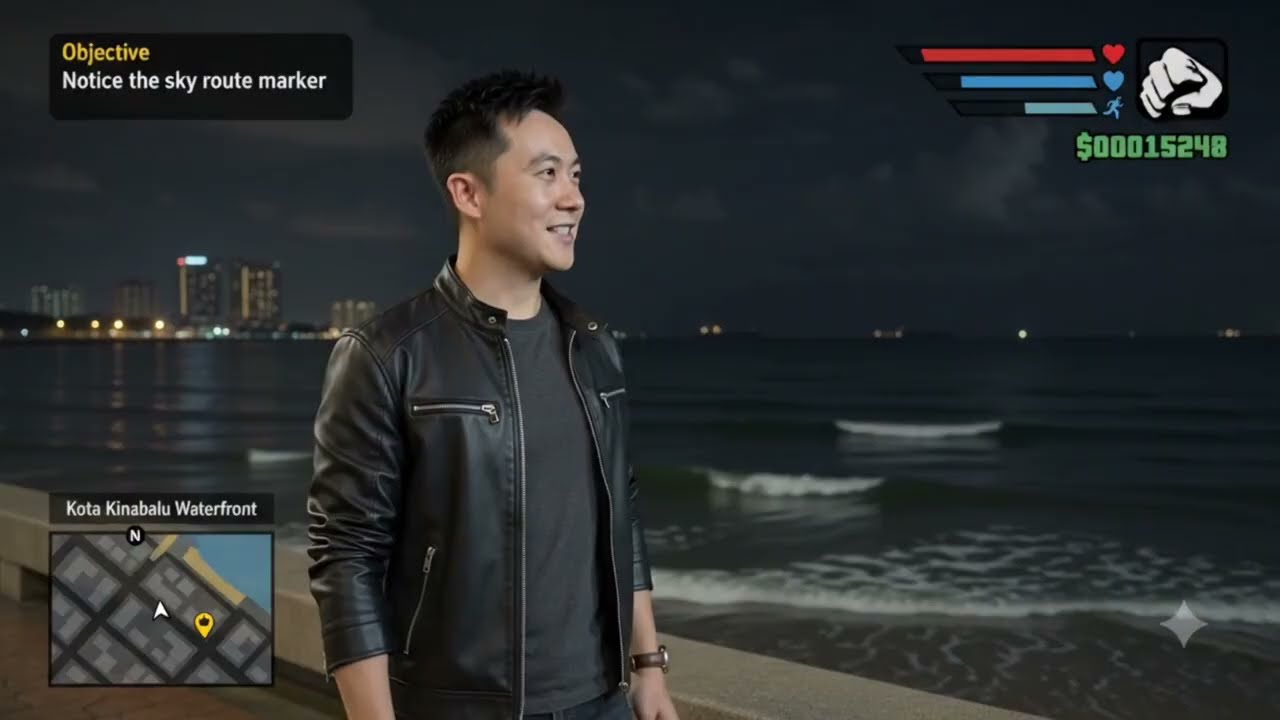
The public film is called If Life was GTA6. It turns travel into side quests and brings the final checkpoint back to Kota Kinabalu. I used a repeated HUD with objective text, map, health bars, and cash counter. My loop was generation, continuity check, selection, regeneration, then a conventional edit with sound.
03
What I learned
Generation produced options. Directing still meant choosing a premise, rejecting broken continuity, and deciding what the audience needed to see next.
PAIN POINTS
What the product addresses
- Strong individual shots that do not cut together
- A protagonist who changes between generations
- Travel scenes with no shared story rule
DECISIONS
Decisions that shaped it
- Use one game premise so very different locations still belong to the same film.
- Keep the HUD visible across scenes as a stable visual grammar.
- Cut or regenerate continuity breaks before the conventional edit.
LEFT OUT
What I deliberately did not build
- A montage of the most spectacular clips with no story or return point.
- Keeping every generated shot simply because it was expensive to make.
MEASURES
What I would measure
- Whether a viewer understands the game premise without reading the description.
- Where viewers leave between one side quest and the next.
- How many shots survive the first continuity review.
EVIDENCE AND BOUNDARIES
What this note is based on
- Visible in the public film: the public YouTube video shows the side-quest premise, Kota Kinabalu endpoint, repeated HUD, travel structure, and continuity changes.
- Ian's account of the production process: my loop was generation, continuity check, selection, regeneration, then a conventional edit with sound. This process is not visible in the public film. Private prompts and generation history were not inspected.
RELATED WORK